
Six formats of work
A format is chosen by the job, not by the name on the list. In the first session we go through your complaint, look at your range of motion and decide together — sometimes 45 minutes of precise point work makes more sense than the 90 minutes of deep work you had in mind.
60 / 90 / 120 minutes from 55€
The core format of the practice. Slow, layer-by-layer work: first the surface tone lets go, then we reach the muscles that hold your body in one position for hours — the erector spinae (m. erector spinae), quadratus lumborum (QL), the glutes. The pace is low, pressure rises with your exhale, and the working discomfort scale is 6-7 out of 10. If you can still breathe, the pressure is right. This is not “grit your teeth if it hurts”.
- A walk-through of your request: where it hurts, when it started, what makes it worse and what settles it
- Range-of-motion tests before and after — forward bend, rotation, raising the arm overhead
- Broad contact with the forearm and the elbow, moving about one to three centimetres per second
- Breathing as the regulator: deeper on the exhale, letting go on the inhale
- Two or three take-home movements at the end, not a list of twenty exercises
60 / 90 minutes from 55€
Softer in sensation, longer in holding. We work with slow drags and almost no oil — what is needed here is grip on the tissue, not glide. The reference points are the links between regions that pull on each other: the thoracolumbar fascia (fascia thoracolumbalis), latissimus dorsi, the shoulder. An honest wording: no pair of hands can “stretch fascia” the way you stretch cloth — what changes is the tone of the muscle underneath and how the layers slide against each other, and that is enough for movement to open up.
- Drags held for 60-90 seconds instead of quick rubbing
- Minimal oil: glide gets in the way here rather than helping
- We check how the skin layers move over the muscle before and after
- A good choice if deep pressure is hard for you to tolerate
- Often paired with gentle work along the rhythm of your breathing
45 / 60 minutes from {{PRICE_EXPRESS}}
A targeted format. A trigger point is a dense spot in a muscle that hurts under pressure and refers pain along a route you already know: from the upper trapezius (m. trapezius, descending part) into the temple, from gluteus minimus down the outside of the thigh. We look for the address the pain is sent from, not the place where you hear it. Pressure is held until the sensation fades, and then the muscle always gets its full range back through movement.
- A search by the referral map — we press where the pain is sent from, not where it lands
- Holding for 20-60 seconds, until the sensation drops by two or three points
- Active movement after every point, otherwise the effect does not stick
- Frequent addresses: upper trapezius, gluteus medius and minimus, pectoralis minor (m. pectoralis minor)
- Three to five points per visit, not twenty: more is not better
60 / 90 minutes from 85€
For people with races and heavy weeks in the calendar. Before the load — a short priming format with no deep pressure; after it — work that brings soreness down and range of motion back. No inflated promises: massage does not make you faster and does not “flush out lactic acid” — it reduces the heavy, clogged feeling and helps you return to normal training sooner.
- The day before a race — surface work only and briefly; deep work waits
- After a long effort — hamstrings, glutes, gastrocnemius (m. gastrocnemius)
- Around the Achilles tendon we work beside it, never on the tendon itself
- The training phase matters: base, volume and taper call for different pressure
- A hotel visit the night before a competition is a routine scenario
30 / 45 minutes from {{PRICE_EXPRESS}}
The format for people who live behind a screen. After eight hours at a laptop it is not only the neck that is short: so are the suboccipitals (mm. suboccipitales), levator scapulae, and pectoralis minor at the front, which pulls the shoulder forward. That is why we work not only along the back of the neck but on the front wall of the chest as well — otherwise the shoulders are back in their old position by evening.
- A quick look at your workstation: monitor height, forearm support, pillow
- Suboccipitals with you face up, slowly, with no abrupt techniques on the neck
- No thrusts and no “cracking”: spinal manipulation is not a massage therapist’s method
- We work the front too: while the chest stays short, the shoulders will not open
- There is a lunch-break version — 30 minutes, no oil, clothes on if you prefer
90 minutes 85€
The whole session on one region. Lower back pain rarely lives in the lower back: more often it is held by the pelvis, the hamstrings and a thoracic spine that has stopped rotating. So in 90 minutes we go through the chain as a whole — from the lower ribs to the back of the knee — and at the end we repeat the same tests we ran at the start, so the difference is visible rather than merely described.
- Lower back, pelvis, glutes and hamstrings in a single session
- Piriformis (m. piriformis) is not the same thing as the glutes: different access, different technique
- Iliopsoas (m. iliopsoas) — no pressing through the abdomen: we work indirectly, through the front of the thigh and the position of the pelvis
- Bend and rotation tests before and after, with the result written into your chart
- Shooting pain with numbness or weakness in the leg belongs with a doctor, not on a massage table
Where to start — in four questions
Answer four short questions and I will suggest a format and length for your first session. If your answers point to a doctor rather than a massage therapist, I will say so plainly.
Four questions I ask before booking
Answer them in a message — from your answers I will suggest a format and length for the first session.
-
What bothers you most?
- Neck and shoulders
- Back and lower back
- Legs after running or the gym
- General tension, stress
- One spot that sends pain somewhere else
-
How long has it been going on?
- A few days
- A few weeks
- Months or longer
-
Do you have any of these?
- Numbness, shooting pain or weakness in an arm or leg
- Fever, a fresh injury, inflammation
- Particular medical circumstances
- None of these
-
What do you want from the session?
- Deep work on the problem
- To relax gently
- To recover for a race or after one
Numbness, shooting pain or weakness in an arm or leg, fever, a fresh injury or inflammation — see a doctor first, not a massage therapist.
Write to me and choose a formatQuestion 1 of 4
What stands behind each name
Technique names in this industry are blurry — different practitioners do different things under the same word. Below is what actually happens in a session with me: what each format is for, who it suits and what not to expect from it.
Deep tissue massage
Depth here is about speed, not about force. Slow, building pressure gives the nervous system time to agree, and the muscle lets go by itself. Fast pressing is met with protective tension, and from that point the two of you are simply wrestling: the therapist pushes, the tissue defends itself, and neither of you gets a result. Hence the working pace of about two or three centimetres per second and the broad tool — the forearm or the elbow instead of a thumb. Broad contact is easier to take and almost never leaves the small bruises that point pressure does.
We go in layers: the surface first — trapezius, latissimus dorsi — then what holds your posture: the erector spinae, quadratus lumborum, gluteus maximus. The reference sensation is 6-7 out of 10. A simple test for correct pressure: if your breathing stays even, all is well; if you hold your breath or clench your jaw, the pressure is too much — say so, and I will take it down. Enduring in silence is not bravery here; it is a way to wake up the next morning with more pain than you started with.
Who it suits
- Chronic tone after long hours of desk work, when a warm-up no longer helps
- The feeling of a “wooden” back and a limited turn of the trunk
- People who have tried relaxing massage before and felt no change
- Strength trainees whose range in the squat and the press has shrunk
What not to expect
- An instant result from one session: the body returns to its habitual posture if the posture is not changed
- Work on diagnoses — hernias, disc protrusions and arthrosis belong to a doctor, not to a massage therapist
- A pleasant nap to music: this is a working format, not a relaxing one
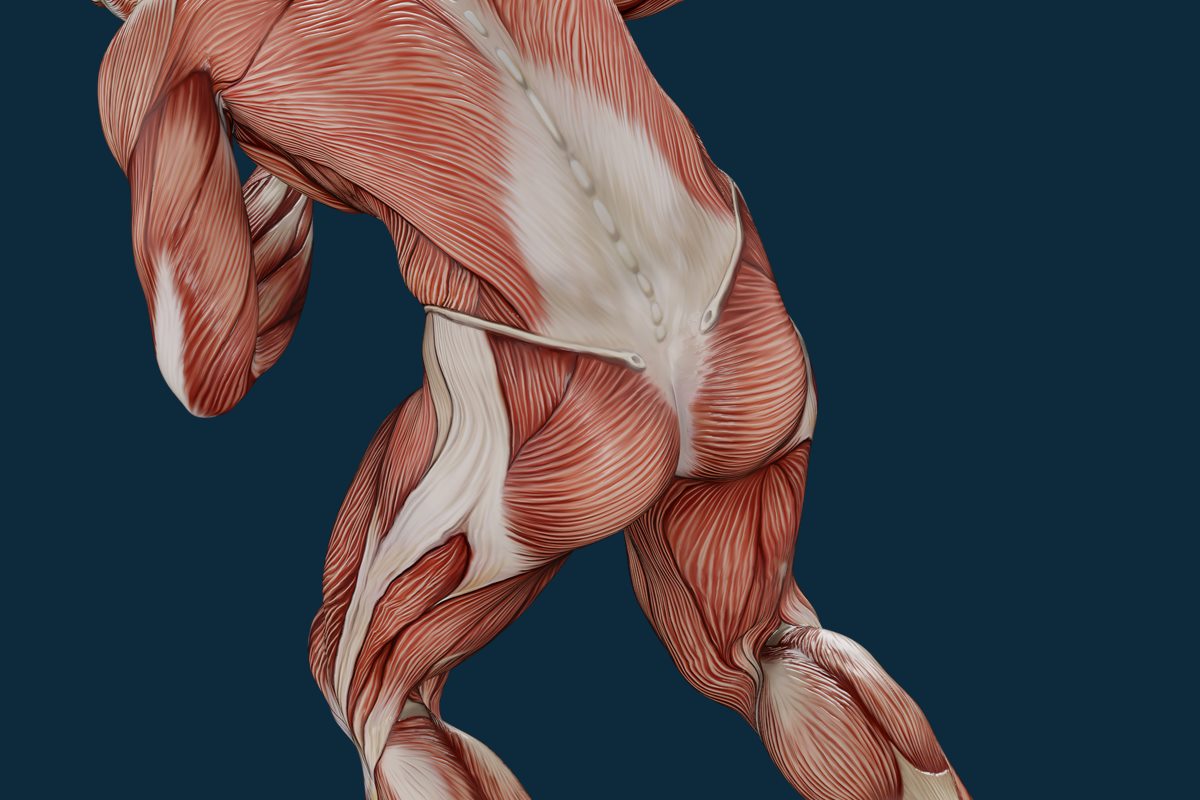
Forward bend, seen from behind: the thoracolumbar fascia links the latissimus dorsi with the glutes and the hamstrings. The lower back in this frame is not a separate area but the middle of a chain, and the pull can come from either end.
- Thoracolumbar fascia (fascia thoracolumbalis)
- Latissimus dorsi (m. latissimus dorsi)
- Glutes (mm. glutei)
- Hamstrings (mm. ischiocrurales)
Myofascial release
Fascia is the dense connective sheath that wraps every muscle and ties neighbouring muscles into one system. The layers are meant to slide against each other; after an injury, an operation or months in a single posture that sliding gets worse, and movement starts meeting resistance where there was none before. The method is slow, gripping pressure with a hold: the hand does not ride over the skin, it displaces a layer and waits.
Honest wording matters here. You cannot tear or stretch a sheet of fascia with your hands — this tissue is far too strong for everyday forces. What does change: the tone of the muscle under the layer, the sensitivity of its receptors and how the layers move relative to one another. We work along links rather than points: latissimus dorsi and the thoracolumbar fascia at the back, serratus anterior (m. serratus anterior) and the obliques along the side wall. People usually describe the sensation as a warm pull rather than something sharp.
Who it suits
- People who tolerate deep pressure poorly but want their mobility to change
- After long immobilization — a cast, a brace, a forced posture
- For a feeling of tightness that is not tied to one particular spot
- As a gentle first session, if you have no idea yet how you react to massage
What not to expect
- Work on old scars without clearance from the surgeon who operated
- A quick effect in 30 minutes: this method needs holding time
- The “kneaded down to the bone” feeling — the logic and the intensity here are different
Trigger point therapy
A trigger point is a small dense area inside a muscle, painful under pressure and referring pain along a consistent route. That referral is its most useful property: a person points at the temple while the cause sits in the upper trapezius; someone complains about the outside of the thigh and we look at gluteus minimus, which lies under gluteus medius and refers down the leg. So the session starts not with hands but with a map: where it hurts, where it travels, which movement reproduces it.
Then comes ischaemic compression: steady pressure on the point, held until the sensation drops by two or three points, usually 30 to 90 seconds. Immediately after that the muscle has to move through its full range, otherwise the nervous system will not remember the new length and will hand the old one back within an hour. Three to five points per visit is a sensible amount. Twenty in an hour is technically possible, but the next day it feels like a hard workout you never did.
Who it suits
- Local pain with a clear referral route that you can point to with a finger
- The dull headache that arrives by the end of a working day — provided a doctor has already looked into its cause
- One specific movement restricted while the rest of the body works fine
- People short on time: the format is brief and addressed to one thing
What not to expect
- Every kind of pain explained through trigger points — that is far from always the case
- General relaxation: this format is pointed and very noticeable
- Treatment for migraine: that is a neurological diagnosis and a doctor’s area of responsibility
Sports and recovery massage
The format adapts to your calendar, not the other way round. Before a start the job is to prepare the tissue and create no new soreness: short, superficial, priming, with no deep work in the twenty-four hours before a competition. After the load the job is different — bring the clogged feeling down and give the range back, so that the next session is trained in full movement rather than at half strength.
The iliotibial band (ITB) deserves a separate word, because runners have it “rolled out” everywhere. It is a fascial cord, not a muscle, and no hand or foam roller can lengthen it: the strengths involved are not comparable. What is worth working on is what weaves into it — tensor fasciae latae (TFL) and vastus lateralis — along with the glutes, which often fail to switch on while running. The sensations are milder that way and the change in movement is far more noticeable.
Who it suits
- Runners and triathletes in volume weeks and after long outings
- Strength sports — between heavy sessions, never on competition day
- Team sports with constant accelerations and hard stops
- Amateurs who raised their training load sharply and got sore for it
What not to expect
- A jump in performance: massage restores, it does not train
- Work on a fresh injury — the first days belong to a doctor, ice and rest
- “Flushing out lactic acid”: it clears on its own within hours, with no outside help
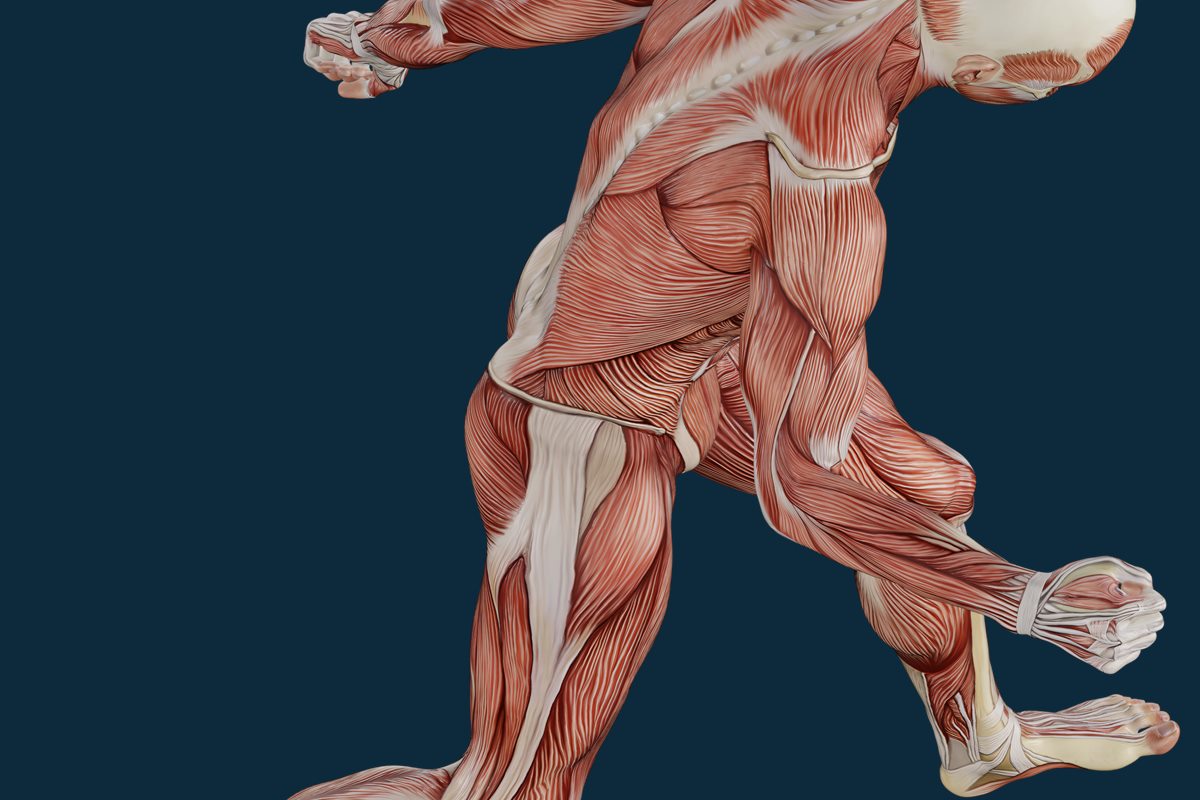
Running stride, seen from behind and to the side: glutes, hamstrings, gastrocnemius and the Achilles tendon work as one spring. After a long effort, soreness most often arrives along exactly this line.
- Glutes (mm. glutei)
- Hamstrings (mm. ischiocrurales)
- Gastrocnemius (m. gastrocnemius)
- Achilles tendon (tendo calcaneus)
Neck and shoulders
The most common request, and the most common mistake made in answer to it. Kneading the back of the neck while a short chest keeps pulling the shoulders forward means starting over every time. The head weighs about five kilograms, and tilting it forward multiplies the load on the back line of the neck: it is carried by levator scapulae (m. levator scapulae), the upper trapezius and the small suboccipitals at the base of the skull, which by evening produce exactly that pressing ache — it spreads from the back of the head forward, to the temple and the eye.
So the session works from both sides. At the back — slow work with you face up, the head resting in my hands so the muscles are not obliged to hold it; that position is what makes the suboccipitals reachable without any abrupt technique. At the front — pectoralis major and minor, otherwise the shoulder girdle returns to its habitual protraction. And separately: a massage therapist does not perform spinal manipulation. No thrusts, no twists, no “cracking” — that is a different profession and a different responsibility.
Who it suits
- Office work and long video calls, especially with a laptop on your knees
- People whose head feels heavy at the back by the end of the day and whose shoulders draw up
- Drivers and anyone who spends more than two hours at the wheel at a stretch
- As a short maintenance format between full sessions
What not to expect
- Adjustments and manipulation of the cervical spine — that will not happen here
- The problem solved without changing your monitor height and your pillow
- Work while you have dizziness of unclear origin: a doctor comes first
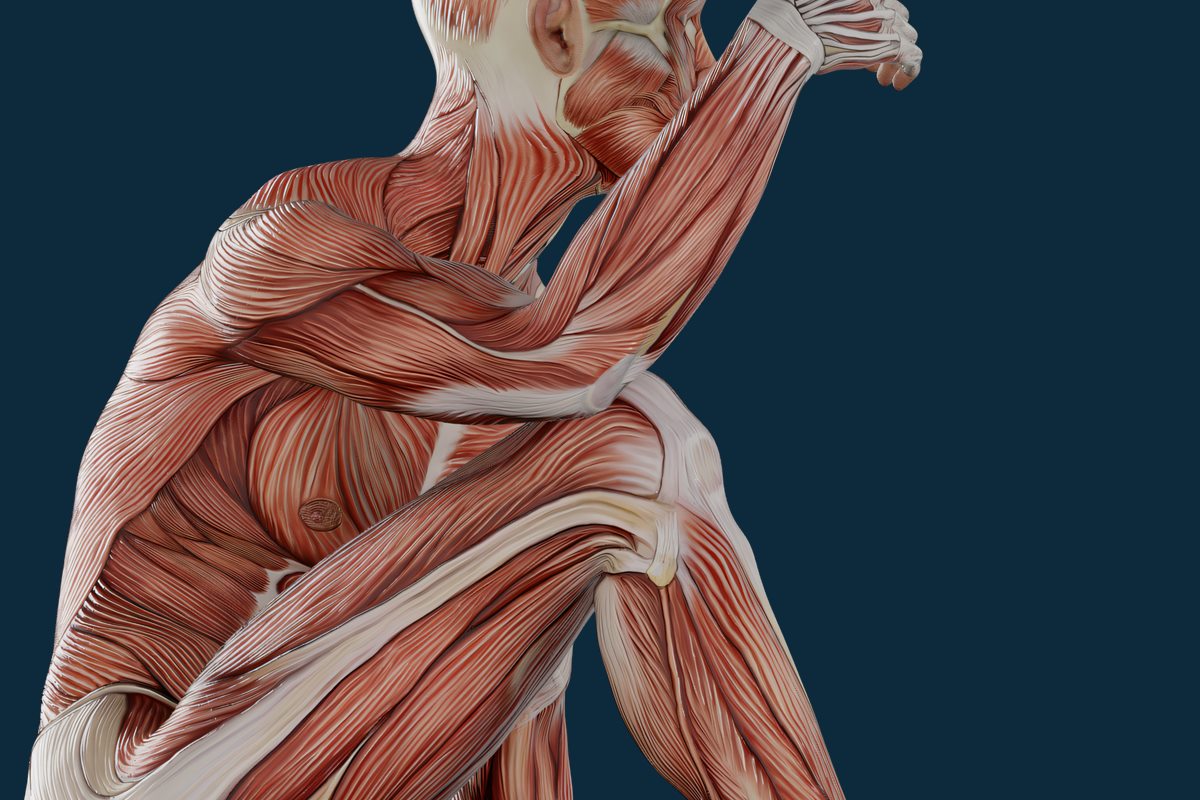
Seen from the side: the neck and the upper trapezius, the deltoid (m. deltoideus), the erector spinae, the glutes, the gastrocnemius. When the head travels forward, this whole line has to carry the weight at once.
- Upper trapezius (m. trapezius, pars descendens)
- Deltoid (m. deltoideus)
- Erector spinae (m. erector spinae)
- Glutes (mm. glutei)
- Gastrocnemius (m. gastrocnemius)
Focus session: back and lower back
An hour and a half on one region is a chance not to hurry. The lower back is almost never autonomous: above it sits a thoracic spine that has stopped rotating, below it the pelvis and the hamstrings pulling the sitting bones down. Knead only the place that hurts and the effect lasts until the evening. Work the whole chain and the change lives longer, because what shifts is the distribution of load, not just the sensation in one spot.
A separate word about piriformis: it is constantly confused with the glutes, although it lies deeper and works differently, and “pain in the buttock” is not automatically it. We do not press iliopsoas through the abdomen: at that depth lie the aorta, the intestine and a kidney, and no advantage of that access has been shown — we work indirectly, through the front of the thigh, the breath and the position of the pelvis. And the main limit of this format: shooting pain with numbness, weakness in the leg or a change in sensation is not a reason to book a massage but a reason to see a doctor soon. Massage is not medical care and does not replace an examination.
Who it suits
- An aching lower back by the end of the day that settles once you lie down
- Morning stiffness that clears after ten or fifteen minutes of moving
- People who spend long hours on their feet or carry a child on one side
- As the first session of a course, when the point is to see the whole picture rather than mute a symptom
What not to expect
- Work in an acute phase with sharp pain — an examination by a doctor comes first
- A diagnosis: the cause of pain is determined by a doctor, not by my hands
- A single visit “so it never comes back”: that needs a course and a minimum habit of moving
How to choose a format
A table for a quick comparison. If you are unsure, send a couple of sentences about the complaint to {{WHATSAPP}} or {{TELEGRAM}} and I will tell you which format makes more sense to start with.
| Service | Duration | Intensity | Main job | Sensible frequency |
|---|---|---|---|---|
| Deep tissue massage | 60-120 minutes | 4 out of 5 | Release chronic tone, restore range of motion | Every 1-2 weeks, less often after that |
| Myofascial release | 60-90 minutes | 2 out of 5 | Restore the glide of the layers and soften the links | Weekly, as a course of 4-6 sessions |
| Trigger point therapy | 45-60 minutes | 4 out of 5 | Clear local points and referred pain | Twice a week for the first two weeks |
| Sports and recovery massage | 60-90 minutes | 3 out of 5 | Speed up the return to full training | By the calendar of races and volume weeks |
| Neck and shoulders session | 30-45 minutes | 3 out of 5 | Unload the neck and shoulder girdle after screen time | 1-2 times a week in a heavy period |
| Focus session: back and lower back | 90 minutes | 4 out of 5 | Work the lower back, pelvis and posterior chain as a whole | A course of 3-5 sessions, then monthly |
Intensity is the range of pressure, not the quality of the work: a two does not mean “it will help you less”. The working discomfort scale is the same in every format — 6-7 out of 10: clearly felt, but with even breathing. If you have to hold your breath, the pressure is too high, and we bring it down right then, not at the end of the session.
How a session is built
Massage is not medical care: I do not diagnose and I do not prescribe treatment. What I do answer for is what happens in those 60-120 minutes — and here is what it is made of, on both sides.
What every session includes
- A walk-through of the complaint and a short assessment: what hurts, when it started, what makes it worse
- Range-of-motion tests before and after — forward bend, rotation, raising the arm overhead
- The plan said out loud before we start: which areas we take, which we leave alone and why
- Strictly therapeutic massage: work under the sheet, with only the working area uncovered
- The right to stop the session at any second — on both sides and without explanations
- Fresh linens for every guest, hand sanitizer, single-use supplies
- Two or three take-home movements at the end — written down if you want them
What the client takes on
- Tell me about diagnoses, operations and medication — anticoagulants above all
- No heavy meal in the hour before the session, and drink water before it, not only after
- Be sober: alcohol means the session is refused, with no exceptions
- Speak on the scale from 1 to 10 while I work, instead of enduring out of politeness
- For a visit to you — a room that fits a table of roughly 190 × 70 cm (75 × 28 in), with a power outlet nearby
- A warm shower is better before the session; right afterwards it is not required
- Warn me about a cancellation in advance: that time is booked for you
When a session is better postponed
- Fever, a respiratory infection, any acute inflammation
- Thrombosis, thrombophlebitis, pronounced varicose veins in the working area
- A fresh injury, a fracture, a sprain in its first days
- A skin infection, a rash or an open wound in the working area
- Uncontrolled high blood pressure
- Anticoagulant therapy — this needs clearance from your doctor
- A cancer diagnosis — only in agreement with your treating doctor
- Pregnancy — this calls for a specialist in the field, and I will point you to one
- Acute pain with numbness or weakness in an arm or a leg — a doctor first
Prices and formats
The price depends on the length, not on the name of the technique: inside a session I combine methods to fit the job. Every format is available both at the studio and on location — travel is charged as a separate line.
Express
One area and one job. Most often the neck, shoulder girdle and upper back during a lunch break.
{{PRICE_EXPRESS}}
30 minutes- One area, without a full body assessment
- Can be done with no oil and with your clothes on
- Works as support between full sessions
- Not the best choice for a first visit
Basic session
The working minimum for deep work: one or two areas at a normal pace, with no rush at the end.
55€
60 minutes- A walk-through of your request and tests before and after
- One or two areas: the back and the neck, for example
- Deep tissue, myofascial release or trigger point work, chosen for the job
- Take-home movements at the end of the session
Full session
The best format for a first visit and for the back and lower back focus session. There is enough time for the whole chain.
85€
90 minutes- A full assessment and detailed movement tests
- The posterior or the anterior chain as a whole, not an isolated patch
- Time for slow pressure — where slow pressure is what decides
- Results written into your chart and a plan for the course
Deep work
For complicated cases and for people who have not attended to their body in a long time: two chains in one visit with no compromise on pace.
105€
120 minutes- Back, pelvis and legs, or the back and the whole front wall
- All techniques combined in a single session
- A detailed look at your habits and your workstation
- Makes sense no more often than once every two weeks
| Package of 5 sessions | 250€ | The format of each session can change as the course goes on |
|---|---|---|
| Package of 10 sessions | 450€ | For people who work with their body systematically, not once in a while |
| Travel within Barcelona | 100€ | The Area Metropolitana de Barcelona districts at the standard rate; further out by arrangement |
| Night session | {{PRICE_NIGHT}} | Outside working hours (09:00–21:00), by prior arrangement only |
| Hotel session | 100€ | I come with my own table and linens — nothing is needed from you |
| Two people at one address | 140€ | Sessions run one after the other, and travel is paid once |
Payment after the session — cash or bank transfer. Travel is charged per address, not per person. If your plans change, let me know in advance: that time is not taken by anyone else. I tell you the final sum before the work starts, once we have gone through your request — there are no surprises at the end.
Short answers
If your question is not here, it is most likely in the full questions section, or you can ask it directly on {{PHONE}}.
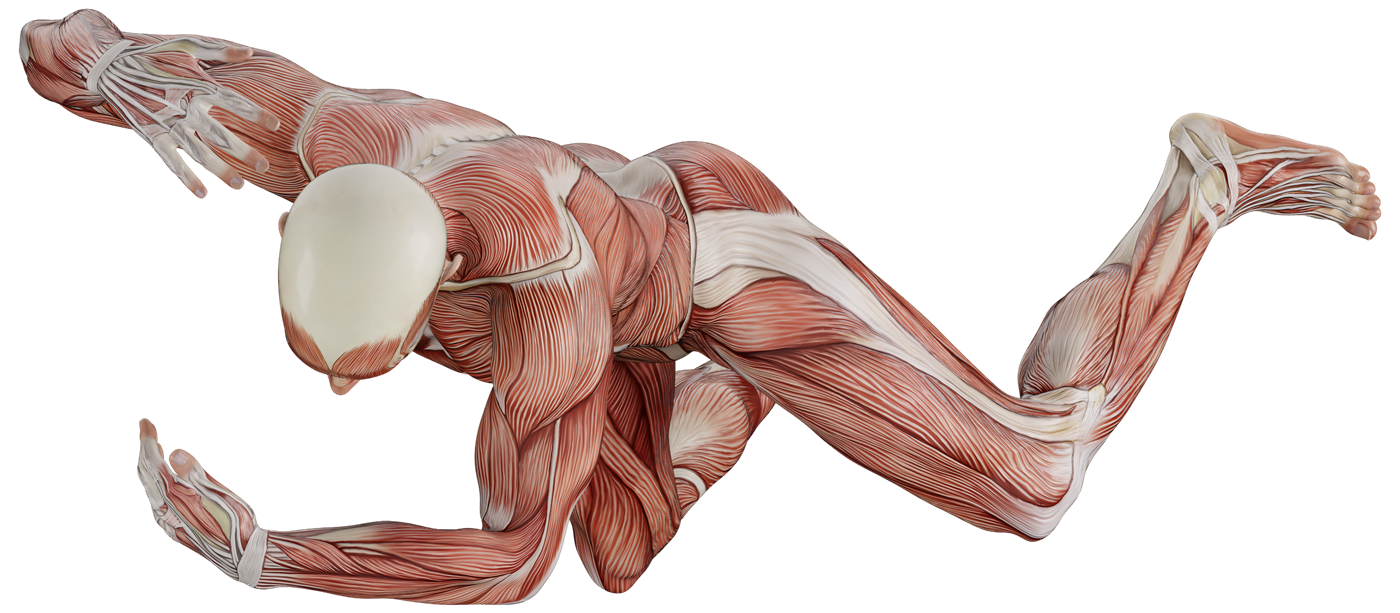
Lying face down is the basic position for deep work on the back: the muscle is relaxed and does not push back against the forearm. Latissimus dorsi (m. latissimus dorsi) · Glutes (mm. glutei) · Hamstrings (mm. ischiocrurales)
Not sure which format is right for you?
Describe in two sentences what is bothering you and how long it has been going on — I will tell you which session makes sense to take first, and whether you need one at all. If what you describe is a question for a doctor, I will say so plainly. The studio is at Balmes 200, I travel across Barcelona and the Area Metropolitana de Barcelona districts, working hours 09:00–21:00.