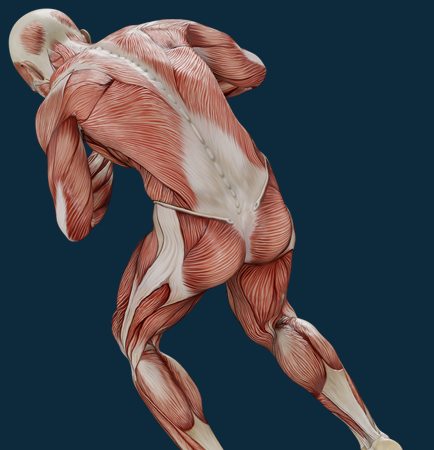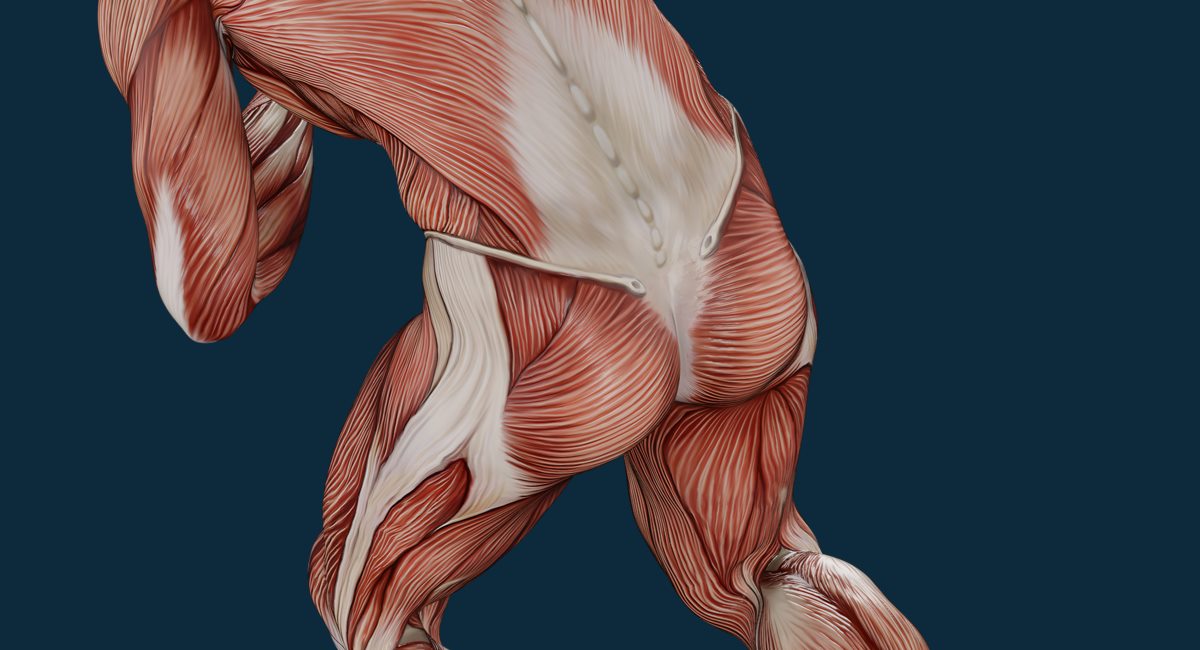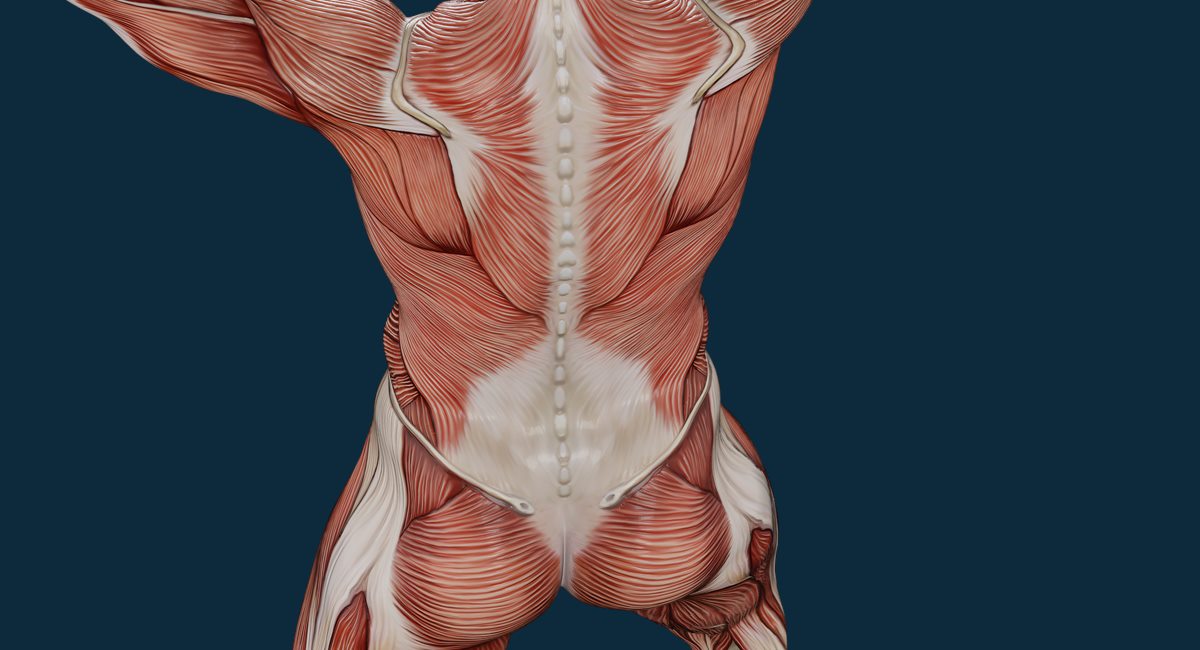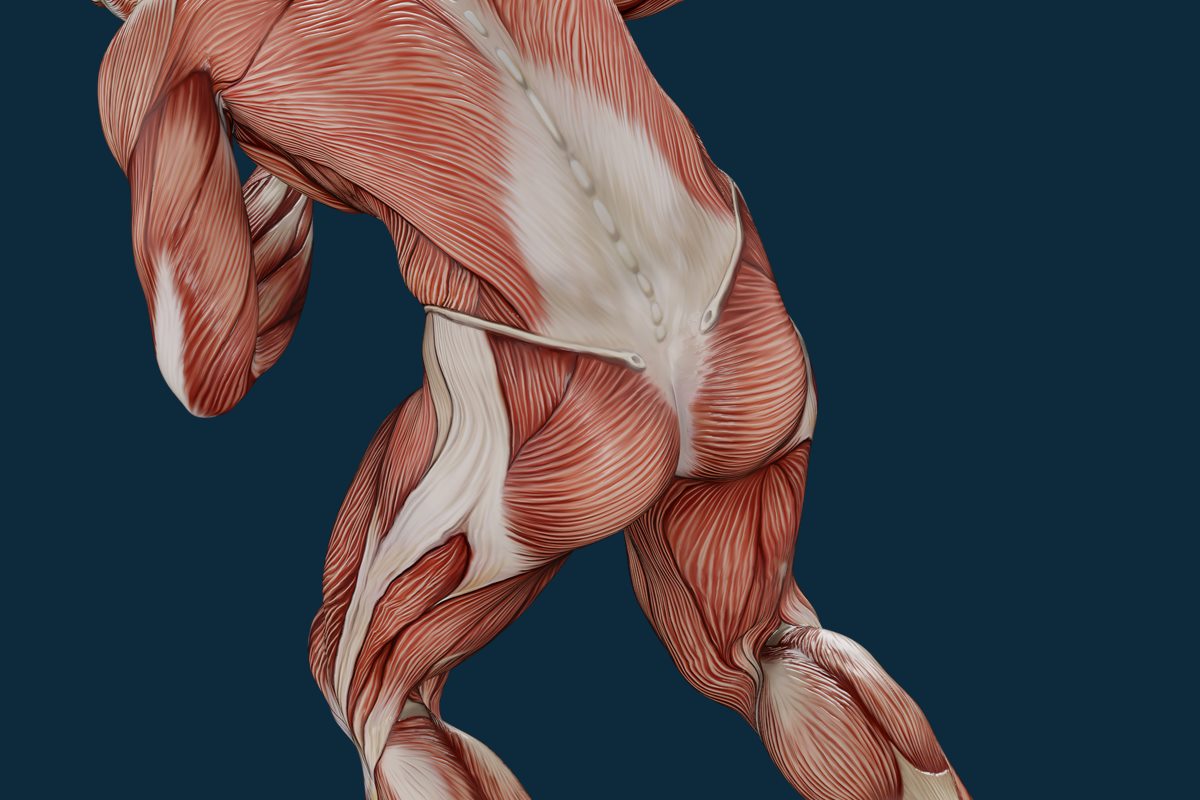
In a forward bend the thoracolumbar fascia is taut and easy to read. This is the sheet that carries force from one glute across to the opposite latissimus.
- Thoracolumbar fascia (fascia thoracolumbalis)
- Latissimus dorsi (m. latissimus dorsi)
- Glutes (mm. glutei)
- Hamstrings (mm. ischiocrurales)
In massage advertising the word “fascia” serves as a universal explanation: everything has stuck together, and now we are going to unstick it. The real story is both more modest and more interesting. Fascia is neither the source of all your troubles nor a magic button; it is a connective tissue wrapping, and its condition decides how freely the layers of your body glide across one another. Below: what is known about it, what is still a hypothesis, what hands genuinely change in it, and why the main work is done by movement rather than by a session.
What fascia is, and why the lower back has a special version of it
Fascia is the connective tissue that wraps every muscle, separates muscle groups, forms sleeves around vessels and nerves, and carries on from one region into the next with no clear borders. If you picture a muscle as an orange, fascia is the peel, the white walls between the segments, and the film around each segment as well. It is made mostly of collagen fibres, which hold shape and transmit force, of elastin, which allows give, and of fibroblasts, cells that constantly rebuild all of it to match the loads you actually put your body through.
For our subject the dense sheets themselves matter less than what lies between them. The layers are separated by loose connective tissue rich in water and in hyaluronan, a large molecule that holds fluid and works as a lubricant. Thanks to it, neighbouring sheets glide across one another by a few millimetres with every movement you make. Those millimetres are precisely the freedom you lose when the body starts to feel wooden.
The thoracolumbar fascia (fascia thoracolumbalis) deserves a paragraph of its own: a dense, multi-layered diamond across the lower back. Latissimus dorsi (m. latissimus dorsi) weaves into it from above, gluteus maximus (m. gluteus maximus) from below, and transversus abdominis (m. transversus abdominis) from the side. The result is a criss-cross construction in which force from the right latissimus can be handed across to the left glute. When you bend down for a heavy bag, the load is not held by “the back” in the everyday sense of the word: part of the work goes into that fascial sheet, and part into the abdominal muscles, which at that moment you do not feel taking part at all.
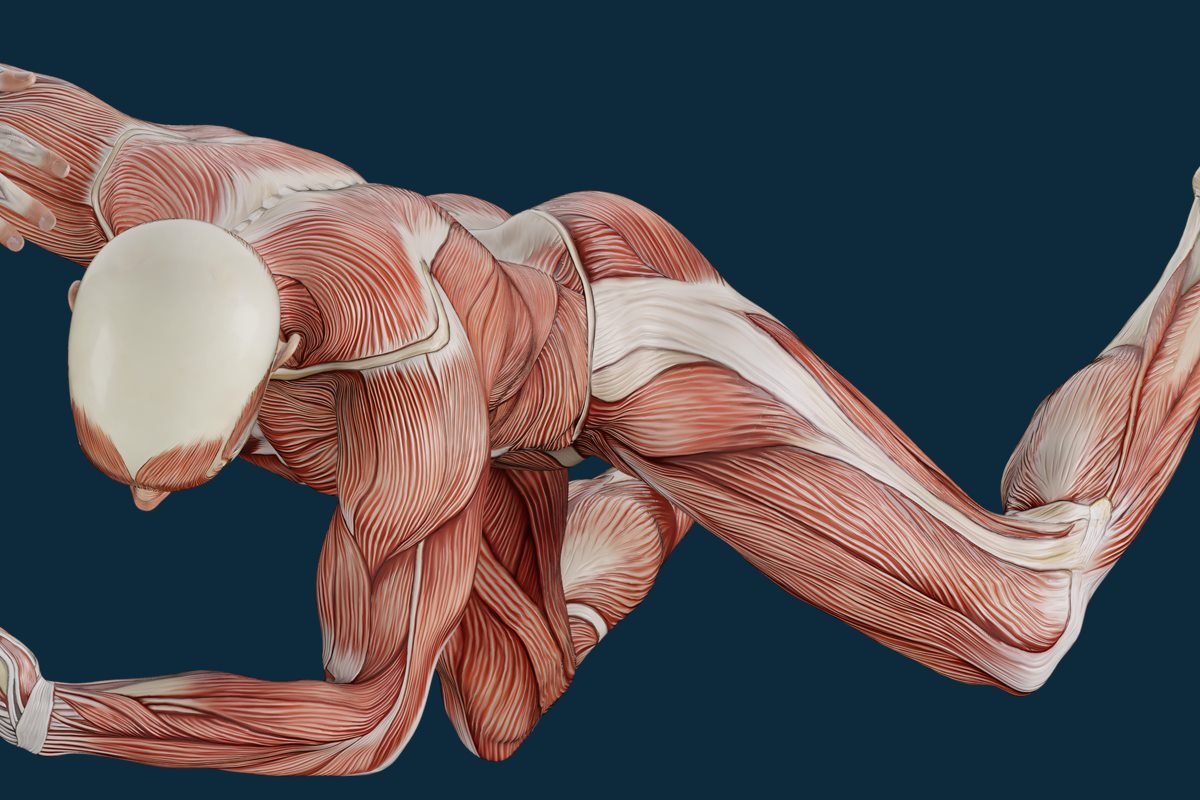
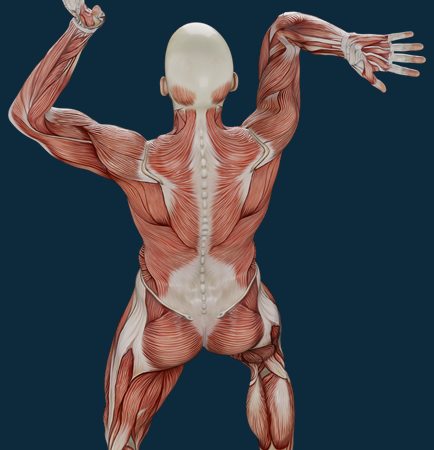
An extended figure seen from behind: latissimus dorsi, the glutes and the hamstrings. Their pull travels not only into bone through tendon but also into the lumbar fascial sheet, which is why “the lower back” is rarely a story about the lower back alone.
- Latissimus dorsi (m. latissimus dorsi)
- Glutes (mm. glutei)
- Hamstrings (mm. ischiocrurales)
Why the body seizes up: what is really going on
A familiar scene: six hours behind the wheel or on a plane, you stand up, and you take your first steps like someone thirty years older. Ten minutes of walking and it lets go. It is worth taking in one simple point here: in ten minutes nothing can either knit together or dissolve. So what changed was not the structure of the tissue but its current properties, the thickness of the lubricant between layers and the muscle tone that the nervous system sets.
The explanation most discussed today goes like this: during long stillness, monotonous overload or local inflammation, the state of that loose hyaluronan-rich layer changes. It becomes more viscous, the glide between sheets gets worse, movement begins to feel like resistance, and receptors in the fascia report all of this to the brain, which adds a little muscle tone just in case. That closes a loop: worse glide, higher tone, worse glide still.
Genuine adhesions are an entirely different matter. They are dense scar tissue that forms after surgery, a serious injury or long immobilization, and it takes weeks to form. You cannot tear it apart with your hands: if finger pressure ruptured dense connective tissue, massage would be a dangerous procedure. The good news is that morning stiffness and a wooden back after a working week usually have nothing to do with adhesions, otherwise fifteen minutes of easy movement would not clear them.

If the stuck feeling goes away after ten minutes of walking, then what stuck was not structure but state. State is something you can influence, both with hands and with movement of your own.
Ale
What hands actually change
Let me start with what they do not do, because that is the more honest end. Hands do not tear adhesions, do not melt fascia and do not rebuild your posture in a single session. Modelling studies are clear: to produce any noticeable lasting deformation in a dense fascial structure such as the iliotibial band (ITB) or the plantar fascia, you would need forces that human hands simply cannot generate. Everything a practitioner describes as “the fascia gave way under my fingers” is explained by other mechanisms.
Mechanism one: the nervous system
Fascia is richly innervated, full of free nerve endings and of mechanoreceptors that respond to pressure, to stretch and to how fast the contact arrives. In density of nerve endings it can rival muscle. Slow, predictable, gradually building pressure reads to the nervous system as safe: protective tone drops, the threshold for tenderness shifts, breathing deepens. Abrupt, unexpected pressure does the opposite and the body closes up. That is exactly why in deep work the pace matters more than the force.
Mechanism two: local glide
Pressure applied with shear, plus the warmth of the hands, temporarily changes the properties of the loose layer between the sheets: fluid redistributes and the glide improves. This is not permanent. The effect lives for hours or days, and what happens next depends on whether you move or go back to sitting for eight hours in one position. So when people talk about locking in the result, I take it literally: what locks it in is your week, not my next session.
Mechanism three: range of motion, which can be measured
The best part is that this effect does not have to be taken on trust. Before the work we check head rotation, side bending, hip extension and raising the arm overhead, and we note exactly where the movement runs into a wall. After the work we check again. The difference is usually obvious at once, and it is an honest criterion: if the range has not changed and the sensations have not changed, then the area was chosen wrongly, and there is no sense in pressing into the same spot any longer.
Myofascial chains: a useful model, not a metro map
The idea of chains sounds elegant: fascial structures are linked into continuous lines running from the sole of the foot through the hamstrings, the lower back and the back up to the base of the skull, so pull one end and the other answers. Popular articles draw these lines with all the confidence of a metro map. In practice that confidence needs to be cut roughly in half.
What is supported: individual transfers of force between neighbouring structures really do exist, and they have been measured on anatomical specimens, where pulling on the latissimus visibly tensions the lumbar fascial sheet and registers on the opposite glute. What is not supported: that a whole “line” works as a single belt, and that neck pain is reliably relieved by working on the foot. Force transmission fades quickly as you move away from the point where it is applied.
Here is how I use the model in practice: as a hint about where to look, not as a recipe. Someone comes in complaining about the lower back, yet barely extends the hip, because they sit for ten hours a day and the front of the thigh has shortened. Working only where it hurts is pointless here: the lower back is covering for range that belongs to someone else. I check the front of the thigh, the obliques and the mobility of the thoracic spine, and only then decide how much time is left for the lower back itself.
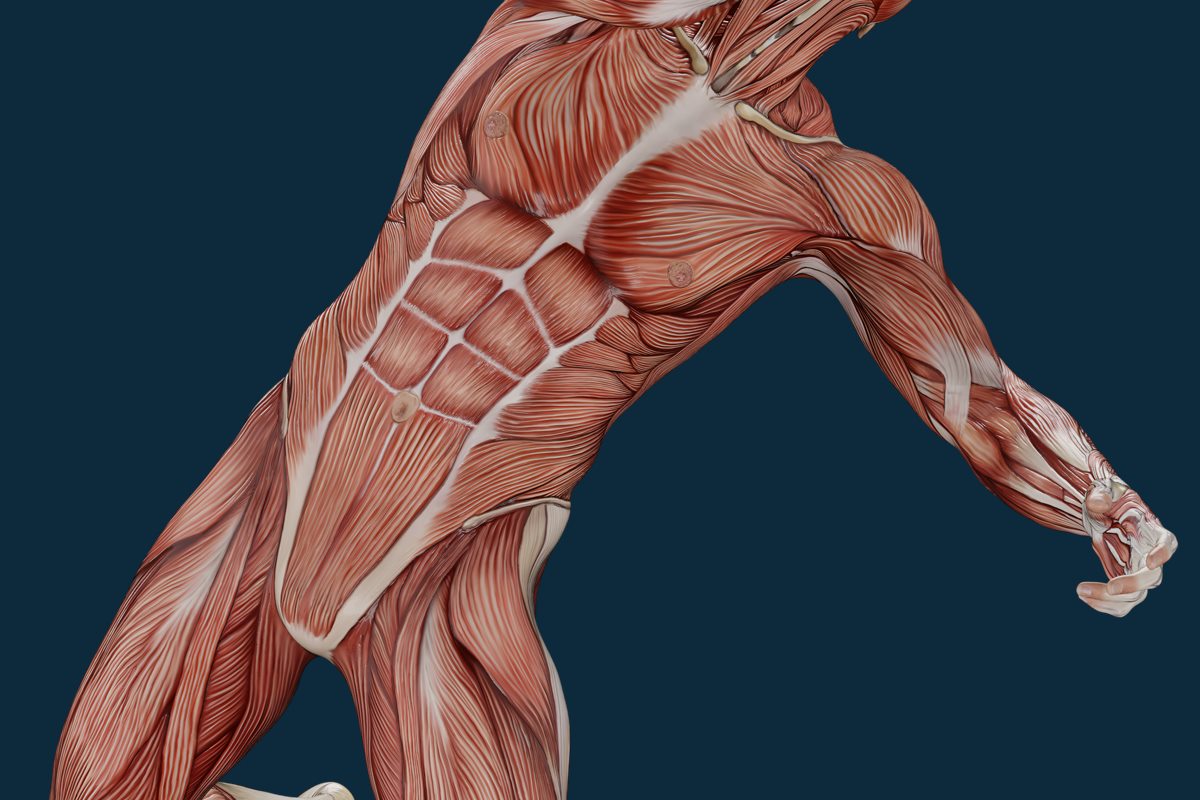
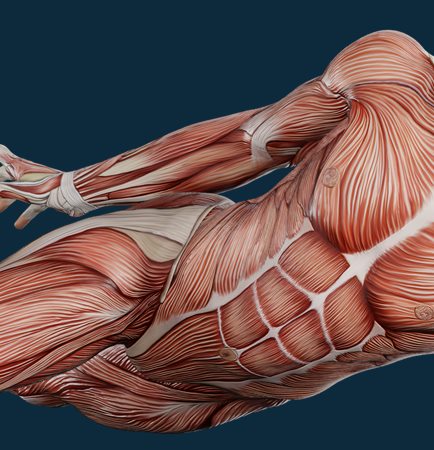
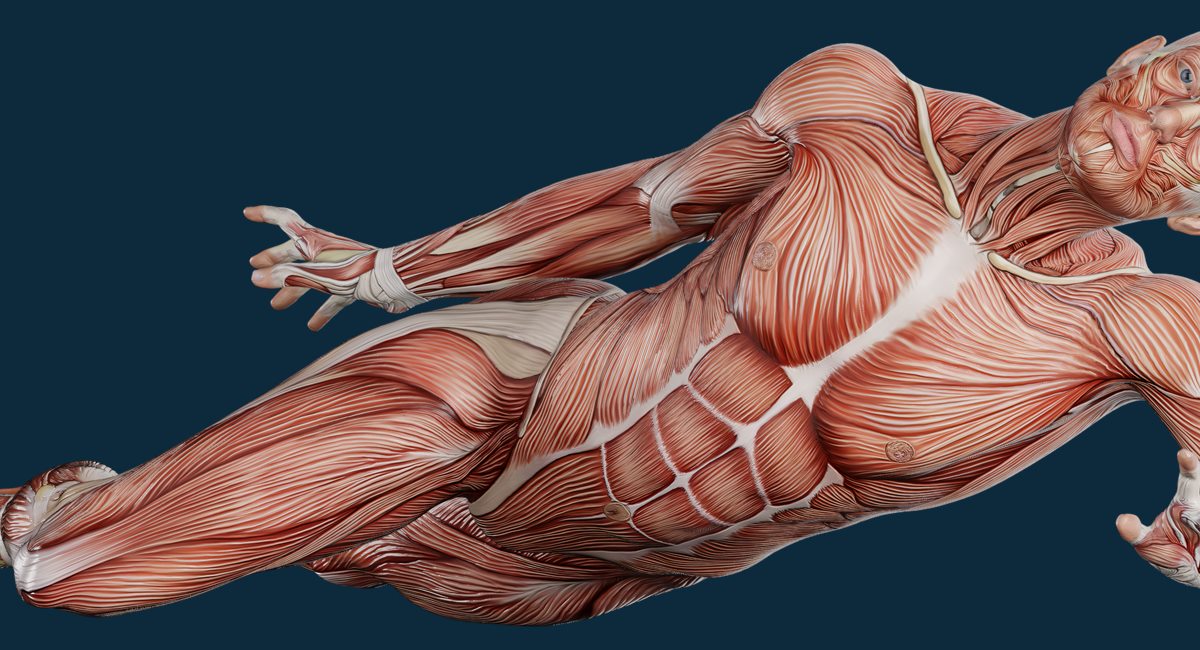
A torso rotation: external oblique (m. obliquus externus abdominis), serratus anterior (m. serratus anterior), rectus abdominis (m. rectus abdominis) and the quadriceps. These are the layers most often forgotten when “the back hurts”, yet turning the trunk starts at the front.
- External oblique (m. obliquus externus abdominis)
- Serratus anterior (m. serratus anterior)
- Rectus abdominis (m. rectus abdominis)
- Quadriceps (m. quadriceps femoris)
Movement, water and sleep: what keeps the glide going between sessions
Strip the romance out of the fascia story and a fairly down-to-earth conclusion remains: the glide between layers is maintained by varied movement through full range. Not by intensity, not by sweat, not by mileage, but by variety and range specifically. Tissue that is regularly taken through everything it can reach keeps its properties; tissue that spends months living in the range between one chair and the next loses them.
- Change position more often than you get tired. Every 40 to 50 minutes, take two minutes in a different shape: stand up, reach your arms overhead, do a couple of side bends and one trunk rotation each way. That is cheaper than any “correct” posture, which you cannot hold all day anyway.
- Go through the full range. One shoulder movement all the way overhead and one squat down to a comfortable bottom give the tissue more than twenty half-hearted repetitions in the middle of the range.
- Drink water sensibly. A dehydrated person tolerates deep work less well and tires faster, that much is true. But “three litres so the fascia glides” is an oversimplification: locally, fluid is redistributed by movement, not by the volume you drank.
- Count sleep as part of the work on tone. Muscle tone is set by the nervous system, and that depends directly on sleep and stress levels. Two weeks on five hours a night and any area will answer pain more readily.
- Do not let a roller replace movement. A foam roller is a perfectly good tool for warming up and for turning sensitivity down before a workout, but it does not roll tissue out. Painful and long does not mean effective.
A separate word about what does not belong in this subject at all. Massage does not cleanse tissue and does not flush anything out; no such processes take place there, and I do not need to invent them in order to explain why you feel better after a session. You feel better because protective tone came down, the glide improved and the range came back. That is enough, and it can be checked on the spot.
How myofascial release differs from deep tissue massage
Both methods work with the same tissues, but they solve different problems and feel different. Myofascial release is slow work across a plane: moderate pressure, direction following the run of the tissue, held until give appears under the hand. Deep tissue massage is targeted: entering layer by layer towards a specific muscle and its attachment, with pronounced pressure, the aim being to take local overload off the place where it sits.
| Parameter | Myofascial release | Deep tissue massage |
|---|---|---|
| What is in focus | The glide between layers and the overall tone of an area | One specific muscle and the point where it attaches |
| Pace and pressure | Slow, moderate pressure, held for 30 to 90 seconds | Slow as well, but pronounced pressure, entering layer by layer |
| How it feels | Drawing, warm, sometimes unfamiliar; there should be no sharp pain | Dense, pinpointed, a working discomfort of 6 to 7 out of 10 |
| When it fits | Stiffness with no clear point of pain, morning woodenness, lost range | Local overload: neck, lower back, glutes, calf |
| After the session | Lightness and more range straight away | Soreness for a day or two is possible, as after unfamiliar exertion |
In practice the two almost always travel together. First soft work across the plane, so that the area agrees to let you in deeper, then targeted work on the particular muscle, and at the end soft work again plus a movement check. And the main rule about pressure, the one I repeat at every first session: if you can breathe, the pressure is right. If you are holding your breath, clenching your jaw or counting down the seconds until the stroke ends, that is not enduring for the sake of results, it is a signal to ease off. Deep tissue is not about endurance, it is about the depth your body is willing to give.
Share:
More articles