Layer by layer: short hip flexors, silent glutes, and a lower back that pays for everyone
Muscles in focus
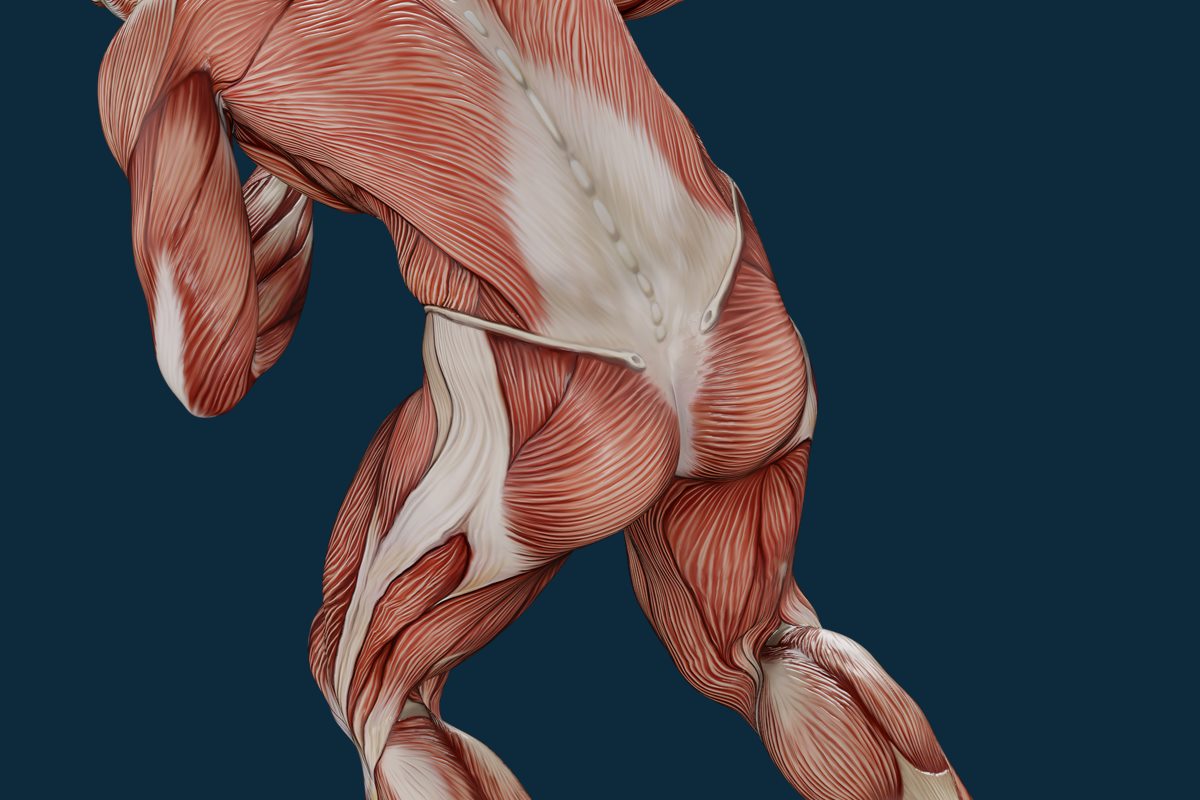
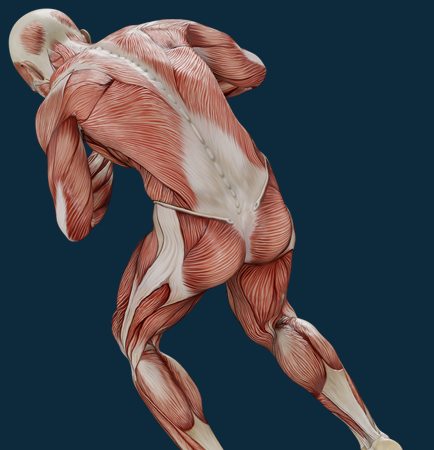
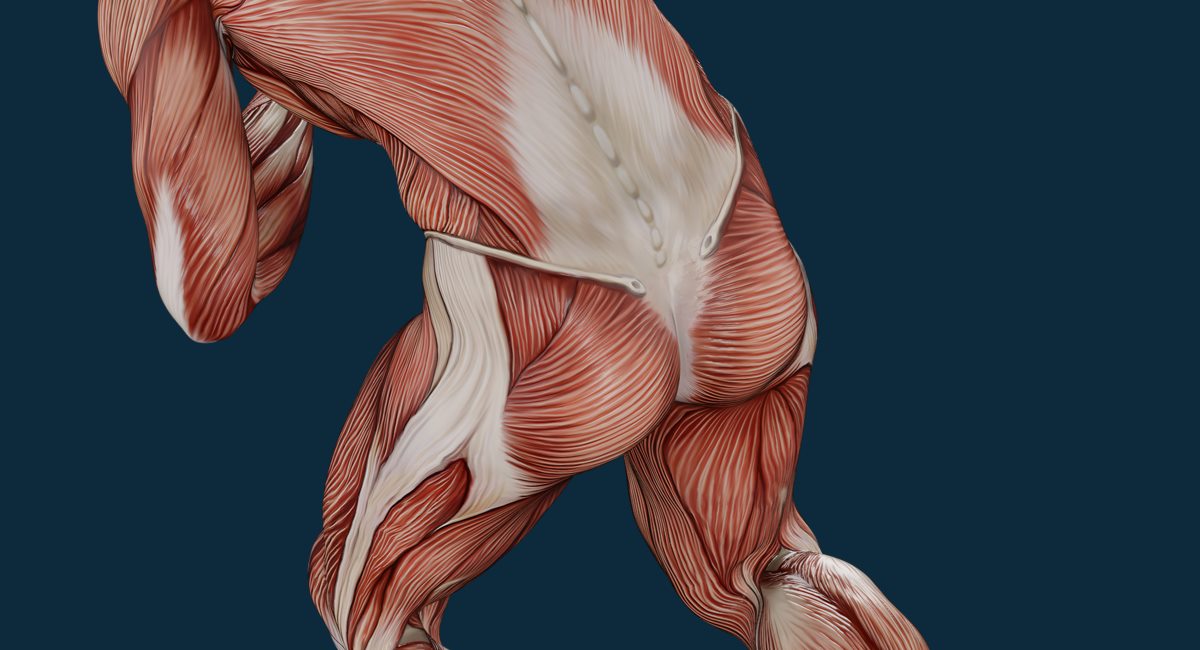
In a forward bend the thoracolumbar fascia is taut and easy to read. This is the sheet that carries force from one glute across to the opposite latissimus.
By six in the evening your lower back aches as though it had spent the day carrying sacks. There was no carrying — there was a chair. That is not a paradox: pain almost never begins where you feel it. Let us go through it layer by layer: what happens over eight hours of sitting, what deep tissue massage can actually work with, and what you will have to do yourself.
Sitting is not rest for your back
Sitting is usually filed away as a passive state: nothing is being lifted, nowhere is being walked to, the muscles are resting. From the point of view of the tissues it is the other way round — you are holding the upper half of your body above your pelvis with almost no help from your legs, and you hold it in one and the same position for hours on end. Pressure measurements taken inside lumbar discs produced a result most people do not expect: sitting loads the disc no less than standing does, and slumped sitting loads it more.
After twenty or thirty minutes in one position, what biomechanics calls creep sets in: ligaments and fascia under a constant load slowly deform, while the erector spinae group (m. erector spinae) goes almost silent in a slumped posture — the passive tissue takes the load instead. Passive tissue does not tire and does not complain, but it responds poorly to an unexpected movement. That is why the classic story — “I bent down for a pen after a meeting and my back went” — is not about a weak back at all. It is about tissue that has spent four hours at exactly one length.
A desk day, muscle by muscle
Who holds the laptop posture
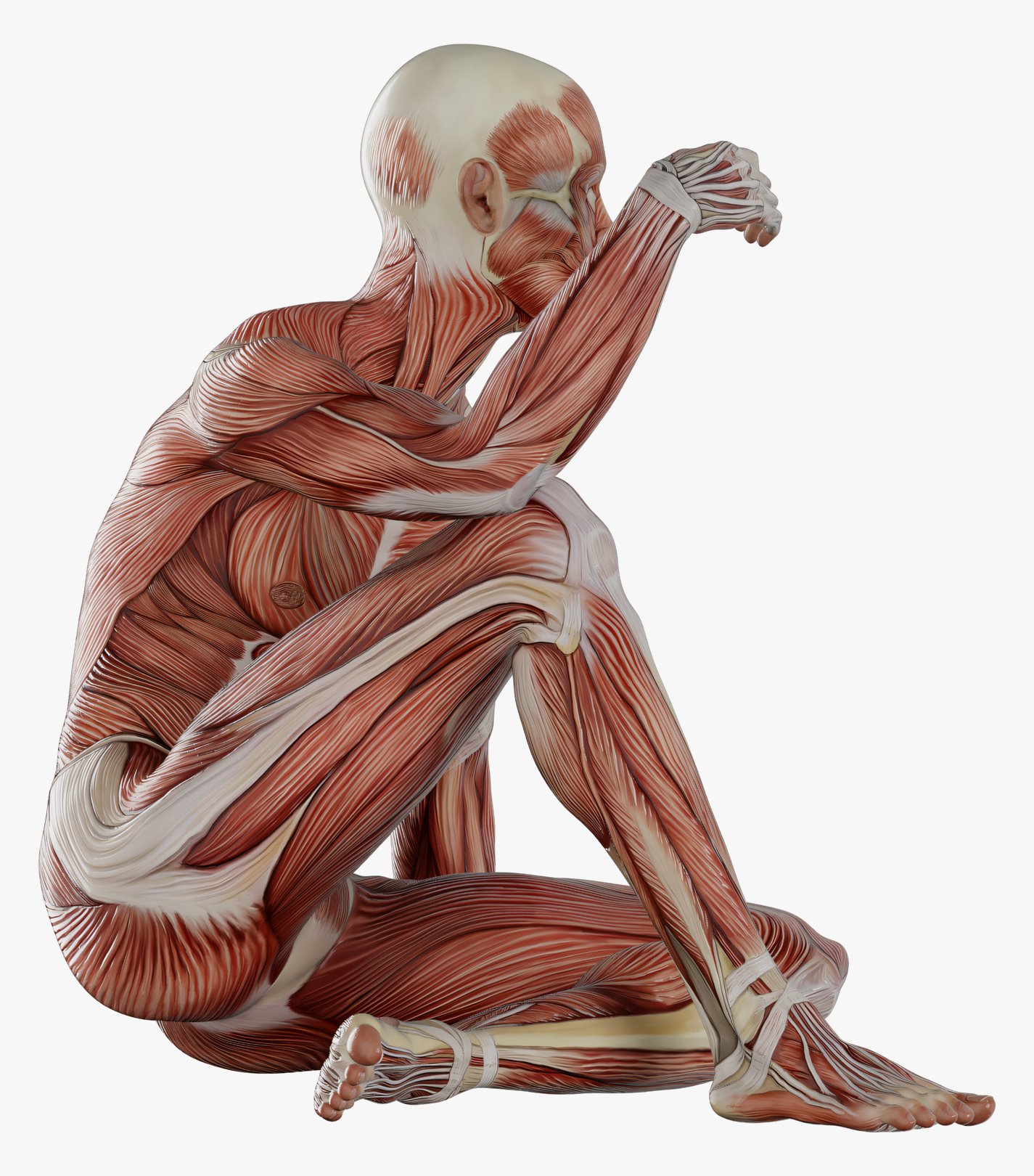
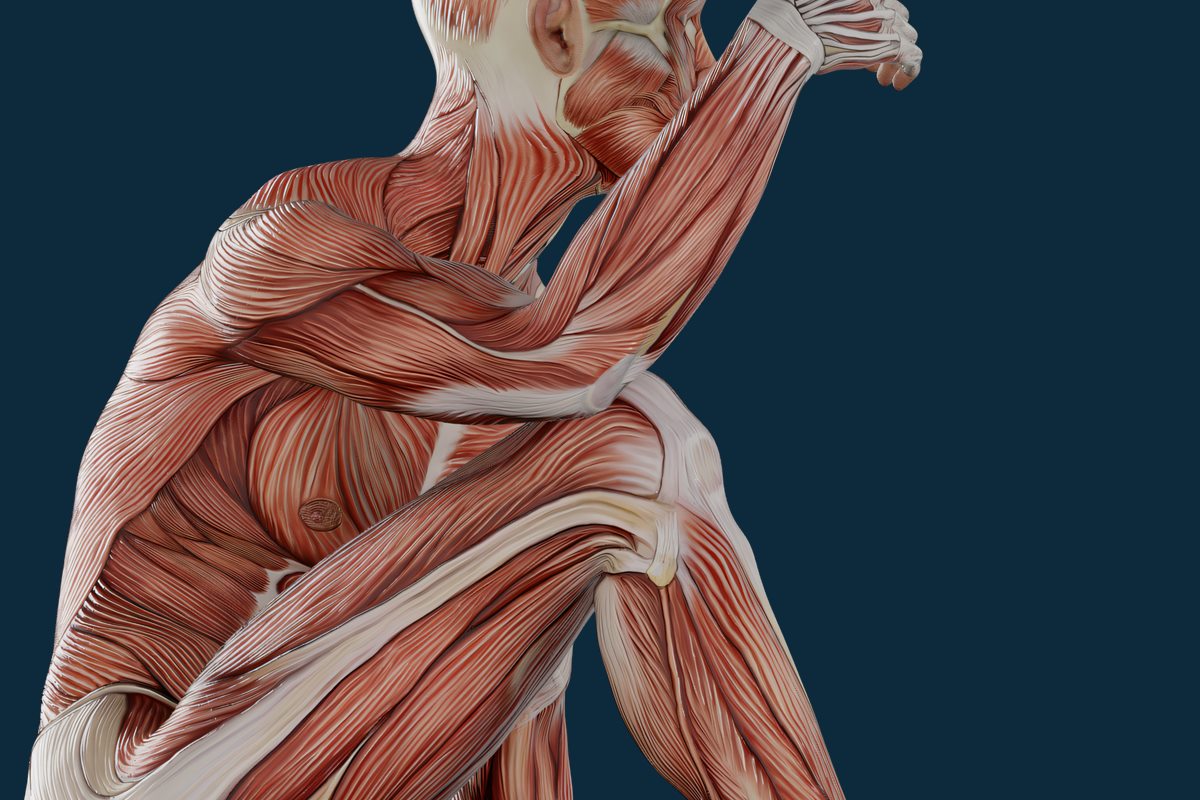
The same eight hours, broken down by muscle. Only the muscles visible on the render are labelled.
Hover over a name or tap it, and its point lights up on the figure.
12345
Holds a head pushed towards the screen. It complains loudest, but the short ones are usually the suboccipitals.
The arm hovers over the mouse all day, so the shoulder never rests, even when you sit still.
The foot sits still under the desk for hours and the calf pump goes quiet: heavy legs by evening.
Rest on the edge of the seat under the weight of the thigh. After long sitting many people feel them pulling, especially when bending forward.
Pressed into the seat by body weight and barely working for hours: the hip stays bent all day.
Render, side view. The spinal erectors are covered by the latissimus here, and the iliopsoas and suboccipitals lie deeper, so they get no labels.
And here is a caveat that is rarely made. The idea that backs hurt because of “bad posture” holds up poorly in the research: people with upright spines have pain, people with a visible slouch very often do not. What predicts better is not the shape of a position but how long it is held. The worst posture is the next one, if it is the same one.
Iliopsoas: a short muscle pulling on your lower back from the inside
The iliopsoas (m. iliopsoas) is in fact two muscles sharing one tendon. Psoas major (m. psoas major) begins directly on the bodies and transverse processes of the vertebrae from T12 to L5 — that is, it attaches to your lower back from the inside and the front — and then passes through the pelvis. Iliacus (m. iliacus) lines the inner surface of the iliac wing. Both end on the lesser trochanter of the femur. It is the only muscle that connects the lumbar vertebrae directly to the leg.
Now put that arrangement into an office chair. The hip is flexed to ninety degrees, the distance between the attachment points is shortened — and it stays that way for eight hours a day, five days a week, for years. The muscle does not shorten irreversibly, but it adapts: its resting tone changes, and so does the length at which it begins to resist. You stand up, it is time for it to let go — and it is still holding, still drawing the lumbar vertebrae forward and down, adding compression to the lowest segment of all.
Hence a complaint anyone would recognize: the first three to five steps after a long sit feel as though you had suddenly turned seventy, and after a minute of walking it eases off. The second marker is a pull “from somewhere inside” that your fingers cannot locate from the outside. Which is logical: from the outside you reach the extensors and the fascia, while the psoas lies far deeper.
An honest caveat belongs here. “Psoas work” through the abdomen — deep pressing with the fingertips — is popular online. I do not work that way and I would not advise looking for someone who does: at that depth you have the aorta, the intestine and the kidney, and there is no evidence that it delivers anything beyond work on the accessible hip flexors and well-chosen positioning. That area answers better to an indirect conversation: through the front of the thigh, the iliac crest, the breath and the position of the pelvis.
Quadratus lumborum does double duty while the glutes do nothing at all
The quadratus lumborum (m. quadratus lumborum, QL) is not part of the extensor group, although it is constantly confused with it. It is strung from the iliac crest to the twelfth rib and the transverse processes of the lumbar vertebrae, it lies deeper, and it is responsible for side bending, for hiking one half of the pelvis upward, and for lateral stability of the trunk. It also anchors the twelfth rib during breathing — which is why in people who spend the whole day breathing shallowly and high in the chest it is rarely a quiet muscle.
QL is a textbook understudy. When the glutes are not holding the pelvis and the hip flexors are pulling their own way, it takes lateral stability upon itself — and usually asymmetrically: whichever side you carry your bag on, cross your legs towards, or turn towards the monitor gets the larger share. That is where “it only hurts on the right, at belt level, just above the hip bone” comes from — the complaint most often mistaken for a kidney.
Gluteal amnesia: what is actually behind it
“Gluteal amnesia” is a colloquial phrase; there is no diagnosis by that name, and the muscle, naturally, forgets nothing. Behind the metaphor is something duller and more honest: gluteus maximus (m. gluteus maximus) is the largest hip extensor you have, and across eight hours of sitting you performed not a single hip extension. Zero repetitions — and for all that time the muscle was pressed against the seat by your own body weight. How much its recruitment really changes is something the data disagree about, but the conclusion holds: work that is never asked for never gets done.
A staircase will show you. Going up, you should push off with the glute of the standing leg. If your torso is being thrown upward by your lower back while the pull runs along the back of the thigh (hamstrings), then hip extension is being scraped together from whatever happened to be nearest. The same goes for gluteus medius (m. gluteus medius): it keeps the pelvis level when you are on one leg, and without it every step lets the pelvis drop slightly sideways — and the lower back compensates with lateral effort, the very effort QL is in charge of. The circle closes: not a “weak back”, but short hip flexors plus glutes nobody asks for plus a lumbar junction that inherited all of the movement at once.
Muscles in focus
Forward bend, seen from behind: the thoracolumbar fascia, latissimus dorsi, the glutes and the hamstrings form one continuous system. The iliopsoas and quadratus lumborum lie deeper and are not visible in the render — which is exactly why people cannot find them on themselves with their fingers.
Thoracolumbar fascia (fascia thoracolumbalis)
Latissimus dorsi (m. latissimus dorsi)
Glutes (mm. glutei)
Hamstrings (mm. ischiocrurales)
The thoracic spine, pectoralis minor and the suboccipitals
The spine divides the labour: the thoracic section rotates and extends well, the lumbar section barely rotates but is stable. Slumped sitting locks the thoracic spine in flexion, the ribs stop spreading, rotation goes away. But the movement itself does not disappear — the neighbours take it over. The rule is simple: if it is stiff above and stiff below, the middle becomes too mobile. That middle is usually the thoracolumbar junction (T12-L1) and the very bottom of the lumbar spine. A hypermobile segment hurts not because it is weak, but because it is covering single-handedly for the entire motionless floor above it.
Text neck
How much your head weighs when you look at your phone
The head itself weighs about five kilograms at any angle. What changes is the lever arm: the further its centre of gravity moves forward of the neck, the harder the muscles at the back have to work to hold it.
Head weight ≈ 5 kg — does not change
Lever arm — grows with the tilt
Cervicothoracic junction (C7)
load on the cervical spine
22kg45°
Phone at chest height. In the model, more than four times the weight of the head.
Who holds the head up
1Suboccipitalsmm. suboccipitalesFour pairs of short muscles between the skull and the first two vertebrae. Their job is precision rather than force — and with the head carried forward they hold it in slight extension all day.
2Neck extensorsmm. splenius et semispinalis capitisSplenius and semispinalis capitis — the main pull along the back of the neck. They are the ones taking the growing lever.
3Upper trapeziusm. trapezius, pars descendensThe most superficial and the loudest: from the base of the skull to the shoulder. It complains first, though it is far from working alone.
Source: Hansraj K. K. Assessment of stresses in the cervical spine caused by posture and position of the head. Surgical Technology International, 2014; 25: 277–279 (original figures in pounds: 10–12, 27, 40, 49 and 60 lb). These are calculations from a simplified biomechanical model, not measurements in living people; for any one person the numbers will differ. Studies do not show a clear-cut link between looking down at a phone and neck pain: how many hours the head stays in one position matters more. The point is not the kilograms but the lever: it grows with the tilt, and the neck extensors hold it for hours.
The lock is held in place by pectoralis minor (m. pectoralis minor) — a small muscle running from the third to the fifth ribs up to the coracoid process of the scapula. Once it shortens, it tips the shoulder blade forward and down, and your shoulders drift forward with no involvement of your will at all. Note this carefully: the back between your shoulder blades is not weak in that state, it is overstretched and overloaded. The burning you feel by the end of the day comes from exactly there, and stretching it in that condition is a questionable idea.
Higher up the story ends with the suboccipital muscles (mm. suboccipitales) — four pairs of short muscles between the skull and the first two cervical vertebrae. Their job is not force but precision: they are packed with muscle spindles more densely than most and are constantly reporting to the brain where the head currently is. When the head is carried forward towards the monitor, they hold it in slight extension for the entire working day. Hence the dull ache running from the base of the skull upward and forward towards the eye, and the sense of wearing a helmet one size too small. After eight hours at a laptop it is not “the neck” in general that is short — it is the suboccipitals and pectoralis minor, while the trapezius (m. trapezius) is simply the loudest one reporting the problem.
Muscles in focus
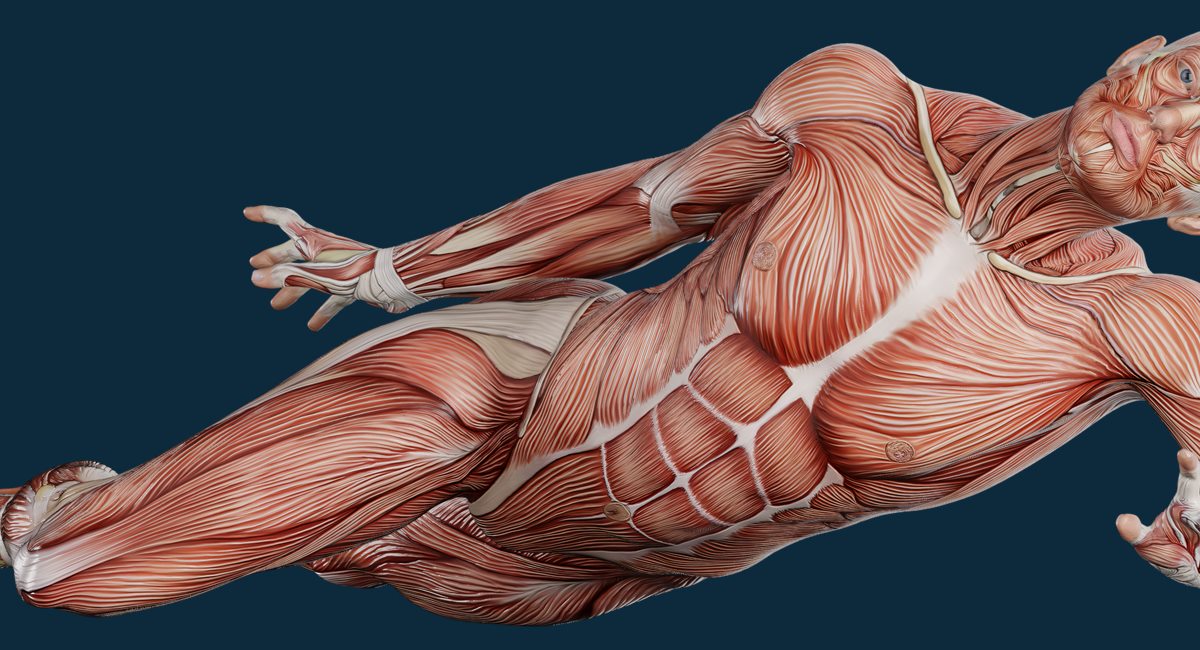
Seen from the side: the neck and the upper trapezius, the deltoid, the erector spinae, the glutes, the calf (gastrocnemius). A working day in its purest form — head carried forward, pelvis tucked under, glutes under body weight and without a single hip extension.
Upper trapezius (m. trapezius, pars descendens)
Deltoid (m. deltoideus)
Erector spinae (m. erector spinae)
Glutes (mm. glutei)
Gastrocnemius (m. gastrocnemius)
What you notice
Who is usually involved
What it does not prove
The first steps out of a chair are hard, a minute later it eases
Iliopsoas and the front of the thigh (quadriceps) held in a shortened position
That something in a disc has “slipped”
It hurts on one side only, at belt level, above the hip bone
Quadratus lumborum doing the work of two muscles
That it is a kidney or a “pinched nerve”
On stairs the pull is in your lower back, not in your glute
The glutes are not switching on in time, and the lower back scrapes the hip extension together
That the glutes are weak — more often they are simply never asked to work
By evening it burns between the shoulder blades and the shoulders have rolled forward
A motionless thoracic spine and a shortened pectoralis minor
That a vertebra needs “putting back into place”
A dull ache from the base of the skull to the eye after a working day
Suboccipitals holding the head in permanent extension
That it is a migraine or blood pressure
When articles are not what you need — a doctor is
Massage is not medical care, and no diagnosis can be made from a text. See a doctor rather than a massage therapist if even one of these is present: increasing weakness in a leg, or a foot that slaps the floor; numbness in the groin area and the inner thighs; any change in bladder or bowel control; pain that followed a fall, a blow or a road accident; pain accompanied by a fever; night pain that wakes you and does not depend on your position; unexplained weight loss; a history of cancer; a sudden sharp attack with loss of sensation. The list is short, but it does not cancel common sense: new, severe or unfamiliar pain is a reason to be seen by a doctor.
What deep tissue massage can do here — and what it cannot
Let me start with the uncomfortable part. For non-specific low back pain, massage gives moderate short-term relief — reviews of the research confirm that much. There is little evidence that the effect holds for months on its own. That is not a reason to skip it, but a reason to understand what you are buying: a window in which moving is easier and less frightening.
Here is what happens in a session as it applies to this picture. Quadratus lumborum is comfortable and safe to reach in a side-lying position — between the twelfth rib and the iliac crest, with slow pressure rather than a jab. The glutes need time: it is a large mass, and five minutes will not cover it. The thoracolumbar fascia answers better to slow, drawn-out strokes than to point pressure. The thoracic spine is work with positioning as much as with hands: the ribs have to be given room to spread. And the suboccipitals are about the weight of your head resting in my palms, not about “pressing into the base of the skull”.
A word about pressure on its own, because there is a great deal of bravado around deep tissue. Deep tissue massage is not “put up with it if it hurts”. The working discomfort scale is 6-7 out of 10: distinct, right at the edge of pleasant, but you are breathing evenly and not holding your breath. If you can breathe, the pressure is correct. If you have tensed up, gripped the table and are waiting for it to be over, the body is defending itself, tone rises, and the point of the work is lost. Say so — I will ease off.
What massage does not do. It does not lengthen a muscle permanently: the effect on length is short-lived and, judging by the data, largely neural — what changes is tone and tolerance to stretch, not the structure of the tissue. It does not put vertebrae back into place. It does not “break up” anything and does not flush anything out of anywhere. And above all, it does not do your hip extensions for you. What it does give you is a day or two after the session when moving is noticeably easier: the best possible time to give your glutes some work, rather than to sit straight back down in the chair.
Muscles in focus
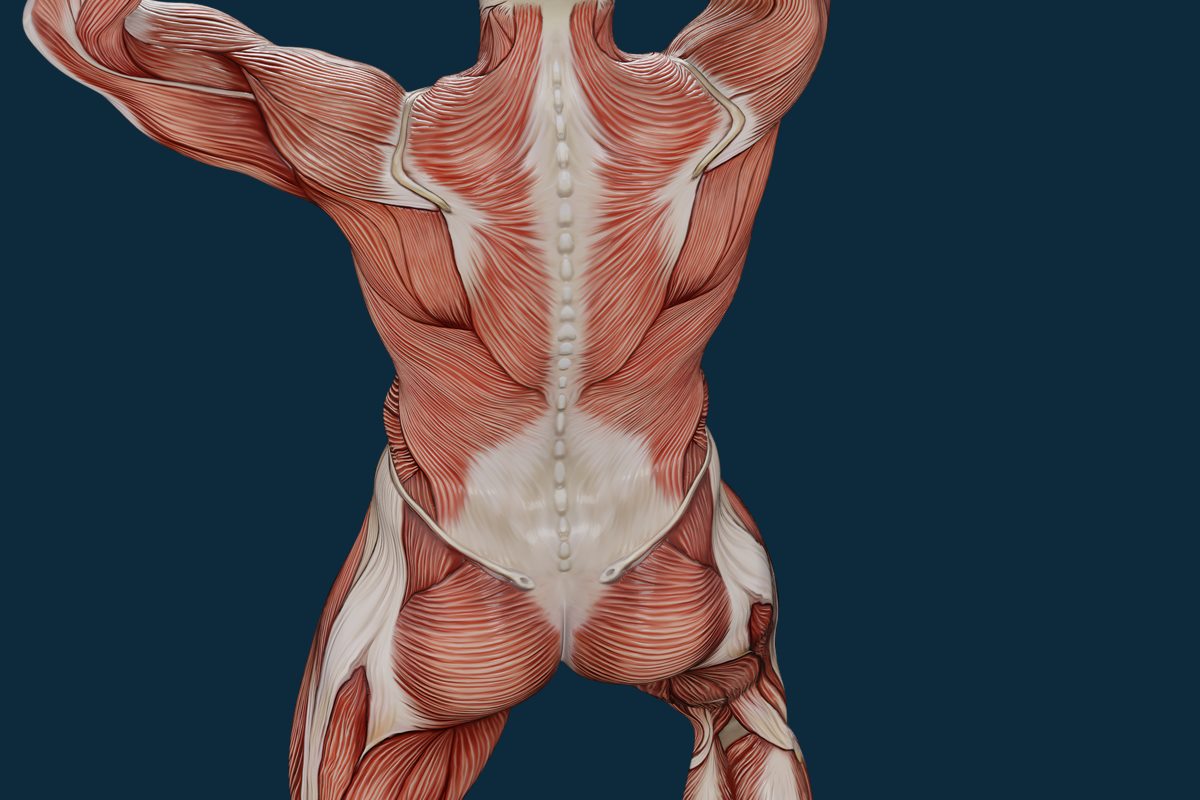
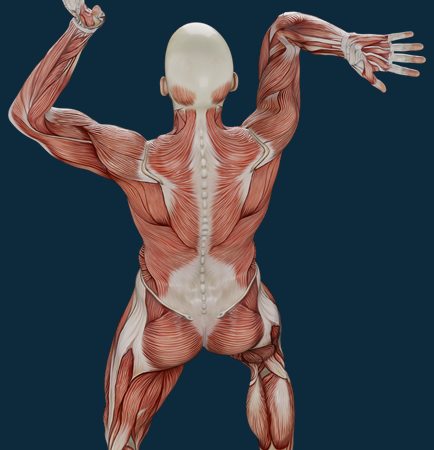
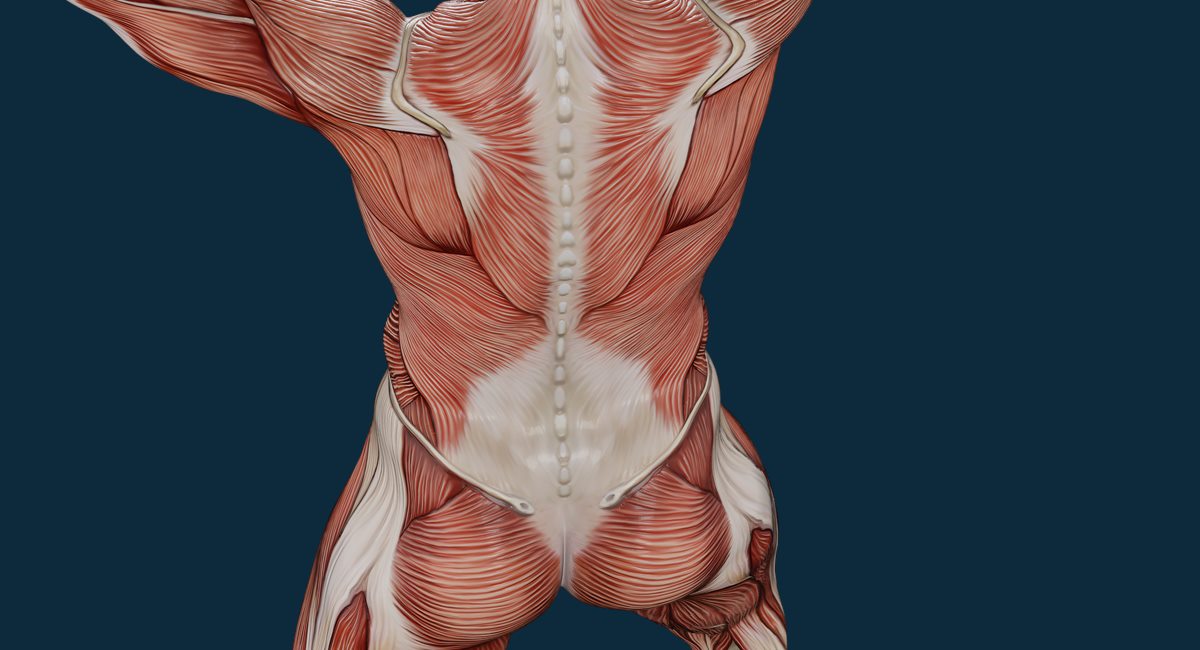
Seen from behind, arms raised: the trapezius in full, the deltoids, latissimus dorsi, the erector spinae, the thoracolumbar fascia, the glutes, the hamstrings, the calves. You can see why a raised arm is also a lower-back matter: latissimus dorsi runs down into the thoracolumbar fascia, and the fascia passes that tension on to the pelvis.
Trapezius (m. trapezius)
Deltoid (m. deltoideus)
Latissimus dorsi (m. latissimus dorsi)
Erector spinae (m. erector spinae)
Thoracolumbar fascia (fascia thoracolumbalis)
Glutes (mm. glutei)
Three things that work without me
Everything below costs less than a session and lasts longer. No equipment is needed — read the description and go by the criterion: it matters more than a pretty shape.
1. Glute bridge — bringing hip extension back
Lie on your back, feet flat on the floor under your knees, hip-width apart. Exhale, press your lower back lightly into the floor, and only then lift your pelvis — up to a straight line from knee to shoulder, no higher. Hold for three seconds, then lower more slowly than you lifted. There is one criterion: the burn belongs in your glutes. If the back of the thigh takes over, bring your feet closer to your pelvis. If you feel your lower back, you have gone into extension — reduce the range. Ten to twelve repetitions, two or three sets, every day.
2. Kneeling lunge with a pelvic tuck — letting the hip flexor go
Kneel on one knee with something soft underneath it, the front foot placed directly under its own knee. Before you shift forward at all, squeeze the glute of the back leg and tuck the pelvis: the pubic bone travels upward, the lower back lengthens. Only now bring a little — very little — weight forward. The stretch will appear in the front of the thigh and deep in the groin. The main mistake is arching the lower back: the arch eats the entire stretch and returns it to the place that already hurts. Thirty to forty-five seconds, two sets per side.
3. Side-lying open book — giving rotation back to the thoracic spine
Lie on your side, knees bent to ninety degrees, a pillow between them, arms stretched out in front of you palm to palm. On the exhale, sweep the upper arm back in an arc, following your hand with your eyes as the ribcage turns. Your knees stay pressed together the whole time: if the knees travel, the rotation has gone into your lower back, and that is not where it belongs. Eight to ten slow repetitions per side. The criterion: you feel the movement in your ribs, not in your lower back.
And the everyday part, without which the first three work at half strength: stand up once every thirty to forty minutes, even if only for a minute — so that no tissue spends four hours in a row at one length. The evidence behind breaks is modest: they reduce discomfort by the end of the day, but they do not promise that your back will stop hurting forever. On the other hand, this intervention costs nothing at all. And where exactly you are short shows up in your range of motion rather than in a description — how a session is built is set out in detail on the page about deep tissue massage.
Key points
Sitting loads the lower back at least as much as standing does, and what harms it first of all is sameness, not “bad posture”.
The iliopsoas attaches directly to the lumbar vertebrae: eight hours with the hip flexed, and it pulls them forward the moment you stand up.
The glutes do not “forget” how to work — they are simply never asked: a working day contains zero hip extensions, and quadratus lumborum and the lower back pick up the load.
A stiff thoracic spine and a shortened pectoralis minor hand rotation over to the thoracolumbar junction, while the suboccipitals hold your head in front of your body all day long.
Massage reliably gives short-term relief and a day or two of easy movement; turning that into a lasting result takes repetitions of your own.
In a session I find by palpation where the shortening is and where the overload is, compare your range of motion before and after, and leave you with two or three things to do during the week. Studio at Balmes 200, visits to homes, hotels and offices — districts Area Metropolitana de Barcelona, working hours 09:00–21:00.